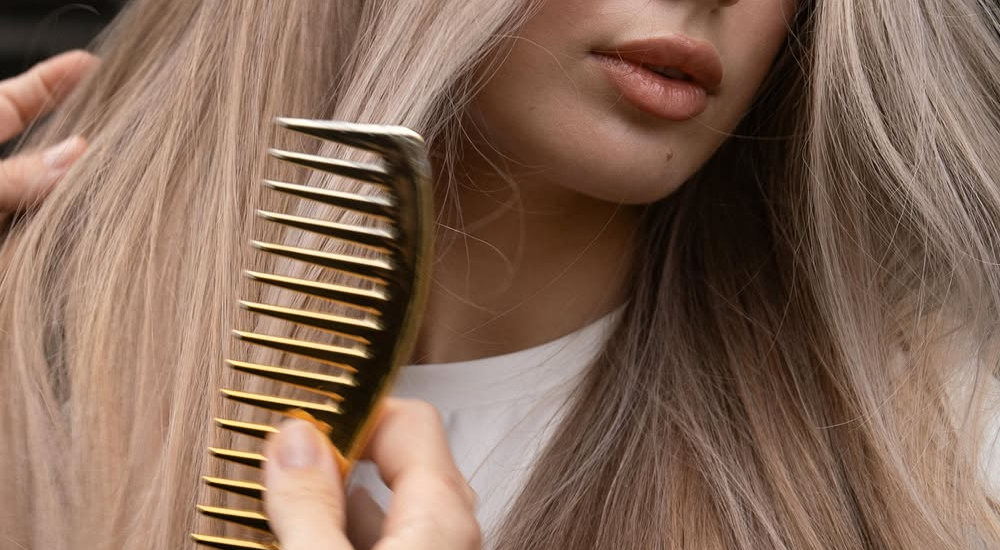
The popularity of AirTouch rests on one thing: color flows softly and naturally, and no hard line appears at the roots. It reads light and current, and it answers the wishes of anyone who wants a fresher shade without sitting in a colorist’s chair every month.
Underneath sits a simple trick: a section is blown through with cool air from a dryer, and the shorter, finer hairs fly out of it. Only what remains goes under lightening, which is exactly why the color never turns flat and the join where natural base meets pale reflections reads smoothly.
The AirTouch effect: what it comes down to
Everything rests on delicate lifting of selected strands. Product never covers the whole mass; the colorist moves section by section. Short hairs get blown away, the rest of the section goes under lightening.
Because of that the color sits more naturally than after even, all-over lifting. Soft tonal shifts, depth and dimension appear.
Where the natural look of AirTouch comes from
No hard border forms between regrown roots and lightened length. Color spreads gradually, and the pale strands mix into the natural tone.
The option suits anyone who likes a brighter hairstyle without strong contrast. When the tone is chosen well, the hair gives the impression of having faded in the sun.
Does AirTouch harm hair?
Like any lightening, this technique is able to stress the hair, provided it is done aggressively or on an already weakened structure. How safe the result turns out is decided by what shape the hair is in, by the product chosen, by processing time and by the aftercare that follows.
Diagnosis before a color change is the key part. The colorist has to establish whether the hair was lightened, colored or chemically straightened before, or ruined by unsuitable care at home.
Who should get AirTouch
The technique is meant for anyone after a soft lift with no sharpness to it. Long hair and medium length reveal it best, since color transitions have room to unfold.
The choice will be a good one if you want:
- a result with no outlined streaks;
- a delicate join between roots and length;
- natural-looking brightness;
- a gentler effect than an intensive all-over lift;
- longer gaps between refreshes than classic blonde asks for.
How long the AirTouch effect holds
Several months is entirely realistic: root growth shows far less than after solid color laid on from the root itself. What tends to drift first is the tone, particularly in cool blonde, which warms up or fades with time.
Toning after lightening is the fix here. It revives the shade without lifting the whole head again and brings the color back to something cooler and more even.
Hair care after AirTouch
Care is built around three tasks: repair, color protection, hydration. Lightened strands react more sharply to heat, to hard water, to cleansing that is too strong.
At home the useful things are gentle shampoos, conditioners made for color-treated hair, repairing masks and heat protection. Cool shades are propped up now and then with yellow neutralizers, though those must never stand in for restorative care.
AirTouch versus classic highlighting: the difference
The color transition here comes out softer, more diffused. Classic lightening leaves treated areas more visible and more regular; AirTouch keeps them subtler.
The work itself differs too. Some of the hair leaves the section under the airflow, so lifting picks up selected fragments instead of the section whole. Hence a more dimensional, more spacious color.
How often AirTouch is refreshed
Refreshing is needed less often than for color laid on from the root itself. Grow-out arrives gradually and usually looks soft, since no hard line forms.
Frequency is set by how fast the hair grows, the shade picked and the care routine. Sometimes a tone refresh does the job, and full color work waits until later.
When AirTouch is worth postponing
Postpone it when hair is badly weakened, brittle, lightened many times over, or recently put through intensive chemistry. Bringing it back into decent shape first, and planning the lift afterwards, is the wiser order — which is what hair care treatments exist for.
Before a color change the colorist should pull up the history of the hair and judge soberly what level of lifting is realistic without undue risk to the structure.
Why a consultation before AirTouch
When the question is not the effect alone but whether the technique will sit on your hair, take a look at how professional AirTouch coloring is done at PIED-DE-POULE.
Anyone whose hair has already been colored, lightened or worn down needs that conversation most. It settles a safe level of lifting and plans an effect to match the length, the condition and the natural base.
FAQ
Does AirTouch work on dark hair?
It does, though the level of lifting runs up against what shape the hair is in and its coloring history. A very dark base often calls for several rounds so the structure is not overloaded.
How does AirTouch look on short cuts?
The technique shows off best on medium and long hair, where the transitions register more clearly. A short cut is no exception, but the pale strands have to be placed more precisely.
How visible is the grow-out?
Less visible than after classic color from the root. The shade stretches from natural base into lighter length without a break, so the line of grow-out never reads harsh.
Can AirTouch go over hair that was colored before?
It can, but first comes an assessment of what shape the hair is in and whatever was done to it earlier. Dark dye in the history, or repeated lightening, calls for a more cautious plan.
What keeps the color going after the procedure?
Reach for lines aimed at lightened, color-treated hair. What counts is repair, protection from heat, and topping the tone up regularly once the shade begins warming.