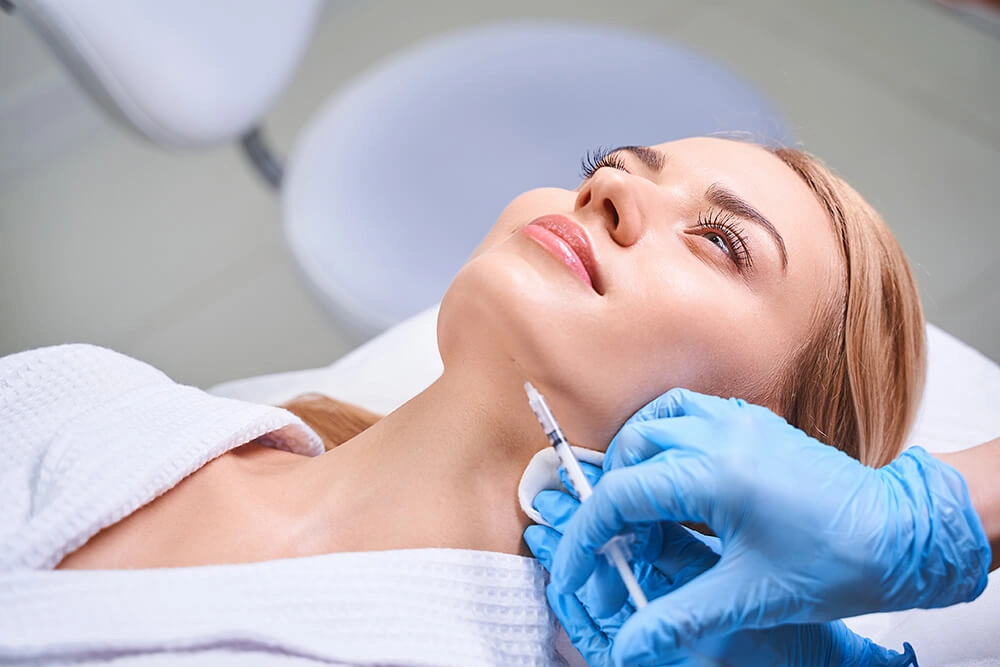
The skin produces hyaluronic acid naturally. It retains water in the tissue, supports elasticity and helps reinforce collagen fibres from within. After the age of thirty, its levels gradually decline year by year — the skin loses volume, the cheeks begin to hollow, expression lines turn into permanent folds, and the facial contour starts to sag.
When injected beneath the skin, the product works in two ways at once. It binds water, so volume is restored immediately — the fold is filled from within, while the skin above it becomes smoother and firmer. At the same time, the gel mechanically stimulates fibroblasts, which continue producing new collagen over the following weeks. The same substance is used in mesotherapy, but in a non-cross-linked form and injected superficially across the whole area — there, the goal is to improve skin quality and hydration rather than restore a specific volume deficit.
Indications — when is the treatment worth considering?
- Expression lines that remain visible even when the face is relaxed
- Frown lines between the eyebrows that create a stern appearance
- Loss of volume in the cheeks and temples
- Downturned corners of the mouth
- Dry, less elastic skin lacking hydration
- Correction of the facial contour, chin and cheekbones
Types of wrinkles and treatment areas
Forehead wrinkle filling
The smooth surface of the forehead can become covered with a network of fine horizontal lines that deepen every time the eyebrows are raised. This area is treated with a fine needle or cannula, using small amounts of product injected superficially — deeper placement in this area could create a heavy, unnatural-looking forehead.
Filling expression lines
These lines develop through movement: laughing, squinting and frowning. They are one of the most common reasons for treatment and are not limited to people over forty — strong facial expressions can make lines permanent even after the age of thirty. Muscle tension that deepens these lines can be relaxed with a facial massage, although massage alone cannot rebuild an already established deep crease.
Filling nasolabial folds
Nasolabial folds run from the sides of the nose to the corners of the mouth and are among the most commonly treated areas. The skin can sink quite deeply here, so more product is needed and it must be placed in deeper layers — superficial filling would only smooth the surface without restoring structural support.
Filling marionette lines
Lines running downward from the corners of the mouth toward the chin can make the face look sad and tired even at rest. Restoring volume lifts the corners of the mouth and improves the lower facial contour.
Filling wrinkles around the mouth
Vertical lines above the upper lip, often referred to as smoker’s lines, can also appear in people who have never smoked — they are caused by the everyday movement of the orbicularis oris muscle. The product is injected in small amounts along each line.
Filling wrinkles under the eyes
The tear trough is a hollow between the lower eyelid and the cheek that can make the face look tired even after eight hours of sleep. The skin here is extremely thin, so the technique must be especially delicate, and a less dense product is used than in other areas.
Hyaluronic acid for wrinkle filling — which products do we use?
We work with certified BELOTERO SOFT and BELOTERO BALANCE gels, as well as Mesha scars. Each of them undergoes a cross-linking process, which means connecting hyaluronic acid molecules into a stable network — this prevents the gel from dispersing through the tissue within a few days and helps it maintain its shape at the injection site. The products differ in density: lighter gels are used under the eyes and around the mouth, while denser products are used for nasolabial folds and areas where the tissue needs to be lifted.
Treatment results
- Wrinkles appear smoother immediately after leaving the treatment room
- Noticeably improved hydration and skin firmness
- Natural-looking rejuvenation without a frozen facial expression
- The full result develops after around two weeks, once the gel has bound water and the skin has begun producing collagen
- Results last from 6 to 18 months — shorter around the mouth, where the muscles move with every word, and longer in more static areas such as the temples and cheeks
Appointments are available in three options: 30 minutes for one area, 45 minutes for two areas, or 60 minutes for facial contour correction involving several areas. Each option includes a consultation, anaesthesia, product administration and shaping. One treatment is enough for most areas; deep nasolabial folds may require a top-up after four to six weeks, while refreshing the same area is usually planned after 9–12 months. Results tend to last longer when the skin is in good condition — biorevitalisation performed between correction treatments can help support it.
Contraindications
- Pregnancy and breastfeeding
- Autoimmune diseases
- Active skin infections and herpes at the injection site
- Tendency to form keloid scars
- Cancer
- Use of blood-thinning medications
- Allergy to any component of the product
Preparation for the treatment and aftercare recommendations
Preparation
- Discontinue aspirin and anticoagulant medication one week before the appointment after consulting your doctor
- Avoid alcohol
- Reschedule dental procedures for another week
- Arrive without makeup and with well-hydrated skin
Aftercare recommendations
- Avoid sun exposure, tanning beds, saunas and intense exercise for several days
- Drink more water
- Do not touch or massage the treated area for 24–48 hours
- Apply makeup no earlier than the following day
- Use SPF 50 every day
- Swelling, redness or bruising may occur — these usually resolve within one or two days
Alternative methods
Botox works on the cause of expression lines by relaxing the muscle that creates them — on the forehead and between the eyebrows, the two methods are often combined. Thread lifts and fractional laser treatments work on skin firmness and structure rather than volume loss. When the main concern is thin, lax skin without clearly defined folds, it may make more sense to start with regeneration: polynucleotides rebuild tissue at the cellular level and prepare the skin for possible future filling.