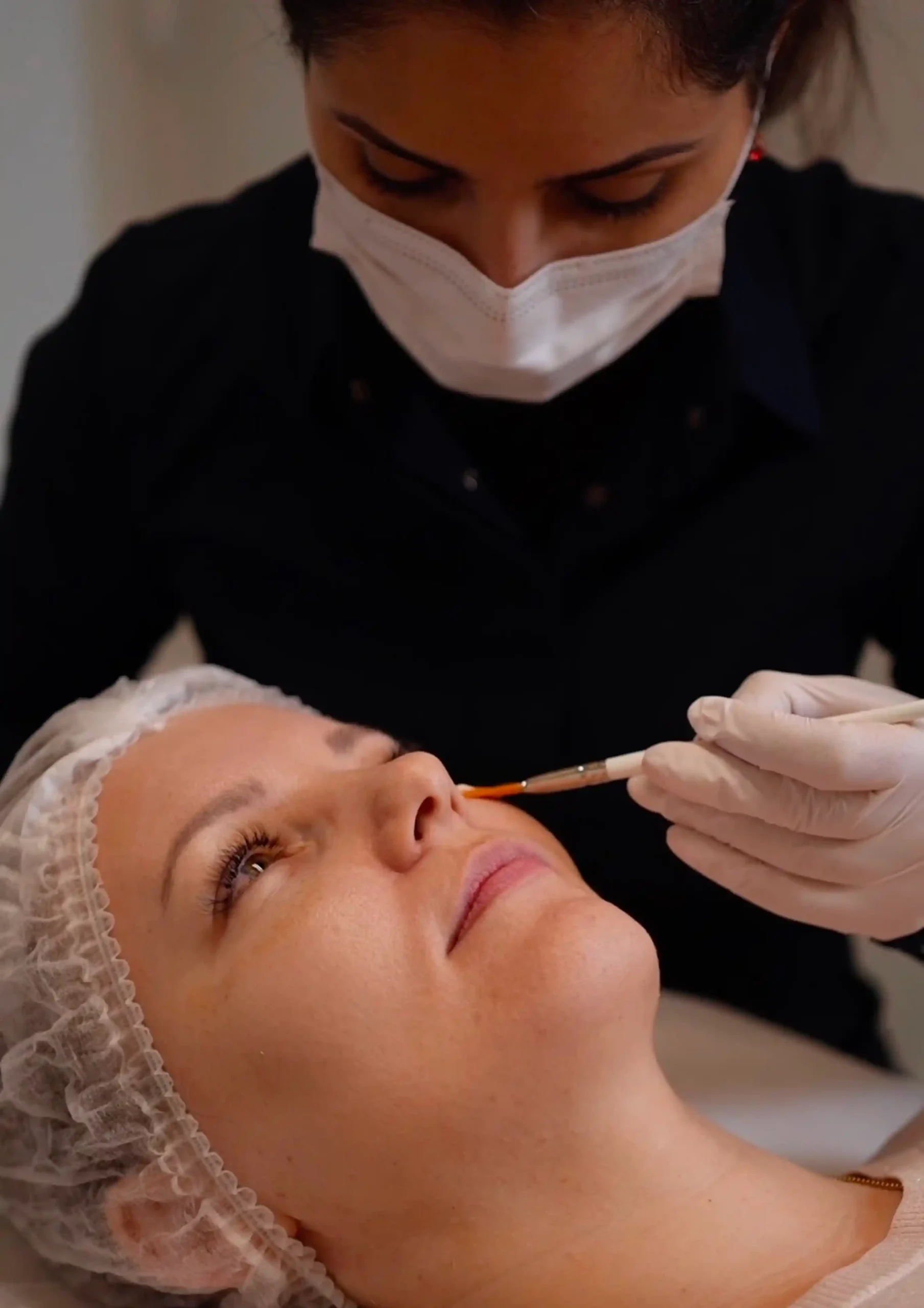
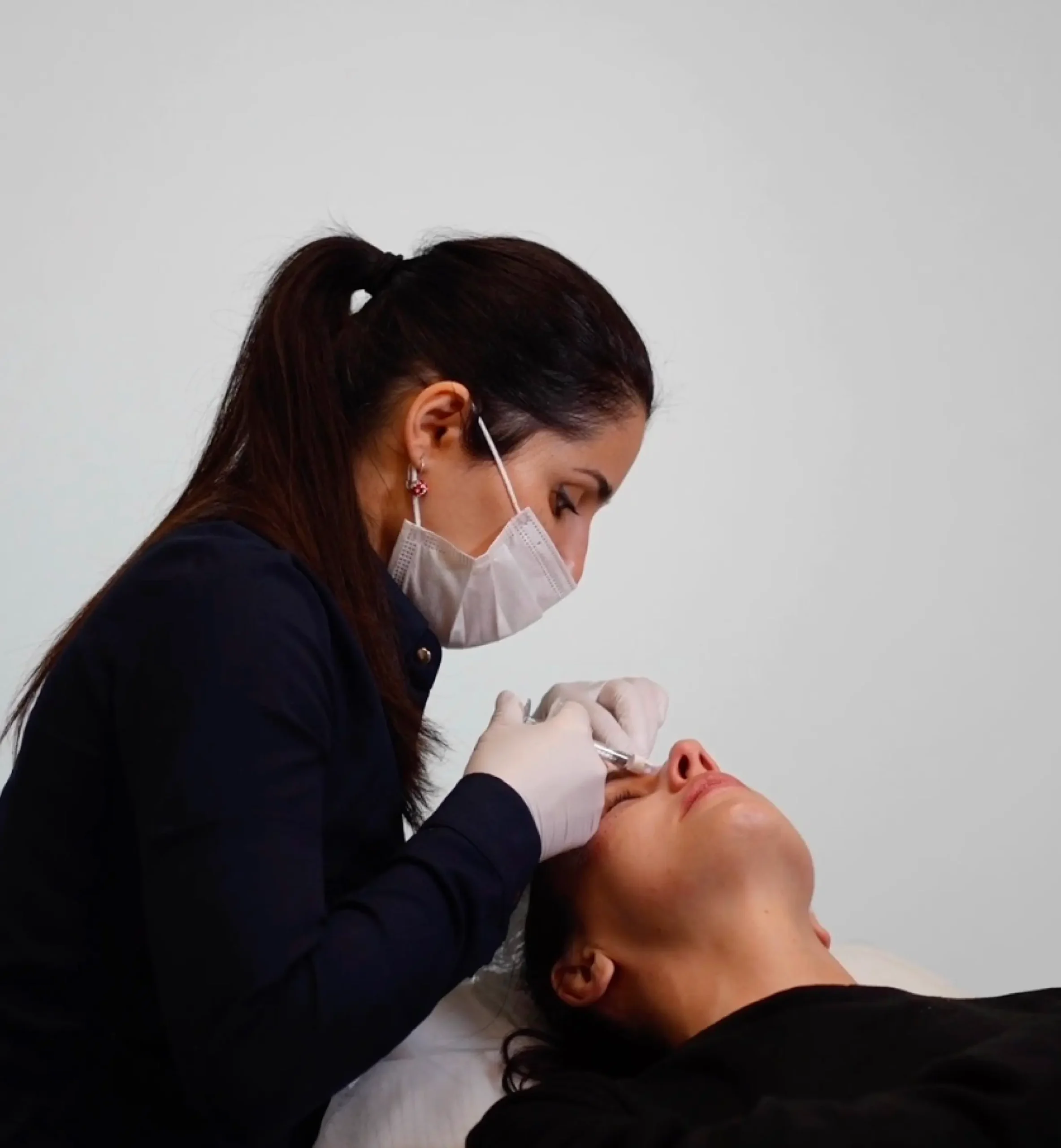
Dermapen is a cosmetology treatment that improves the quality of the skin itself: it evens out its texture, improves its density and brightens the complexion instead of simply masking imperfections for a short time. The treatment is also known as microneedling mesotherapy because it combines the action of needles with a cocktail of active ingredients. It can be performed on the face, neck and décolletage, and you can return to your usual routine afterwards because the visible signs subside within a few days.
How Dermapen Works and What Microneedling Involves
The Dermapen device itself resembles a thick pen with a replaceable, single-use cartridge at the tip. The cartridge contains several fine needles that move vertically up and down at very high speed. The latest version, Dermapen 4, has 16 needles and performs more than 1,900 punctures per second. The cosmetologist adjusts the depth in 0.1 mm increments: the shallowest setting is used under the eyes and the deepest on scars.
During the treatment, the cosmetologist moves the device across the skin like a brush, and each pass leaves hundreds of microchannels only a fraction of a millimetre deep. Each puncture triggers a brief, controlled inflammatory response. Cells release growth factors, fibroblasts begin producing collagen, elastin and hyaluronic acid, and tissue remodelling continues for several months after the appointment. The microchannels close within a few hours, so the cosmetologist uses this window to apply Dermapen products containing hyaluronic acid, peptides, amino acids and vitamins selected according to the concern being treated.
Dermapen vs Dermaroller, Injectable Mesotherapy and Biorevitalisation
A dermaroller rolls across the skin, so its needles enter and leave at an angle, pulling at the epidermis. Dermapen needles enter perpendicularly and at the same depth at every point, while the narrow tip can reach the sides of the nose and the under-eye area, where a roller cannot fit.
Traditional injectable mesotherapy leaves individual deposits of product beneath the skin, while biorevitalisation introduces hyaluronic acid mainly to hydrate the skin from within. Dermapen works across a broader and more superficial area: it remodels the structure of the entire skin surface, making it better suited to enlarged pores, scars and uneven texture.
Who Is Dermapen Suitable For?
It is worth considering Dermapen if you recognise any of the following situations:
- Foundation settles into the pores on your nose and cheeks, while in daylight your skin looks rough.
- Your acne has cleared, but it has left depressions that become visible in side lighting.
- Your face looks tired even after a holiday, and highlighter no longer makes a difference.
- Fine lines around the eyes and mouth become deeper from season to season.
- Your cheeks have lost firmness and your jawline is less defined.
- Brown marks left after summer or breakouts refuse to fade.
- Your neck and décolletage look older than your face, and wearing a high-neck jumper has become a necessity rather than a choice.
Dermapen Contraindications
Before the treatment, the cosmetologist asks about your health, medication and recent procedures because some contraindications rule the treatment out completely, while others simply mean postponing your appointment.
The treatment cannot be performed if:
- you are pregnant or breastfeeding;
- you have an autoimmune condition, uncontrolled diabetes or cancer that is currently being treated;
- you are prone to hypertrophic or keloid scarring;
- you have a blood-clotting disorder or take anticoagulant medication;
- you are allergic to lidocaine in the numbing cream or to ingredients in the mesotherapy cocktail, PRX-T33 or BioRePeel.
The treatment is postponed if:
- there are pustular breakouts, cold sores or another bacterial, viral or fungal infection on the face;
- psoriasis, atopic dermatitis or rosacea is flaring up in the treatment area;
- your face is freshly tanned or you have used a sunbed within the previous two weeks;
- you have taken isotretinoin within the previous 6 months;
- you have had botulinum toxin, a filler or a strong chemical peel within the previous two weeks.
For clogged pores and active inflammation, the cosmetologist begins with a course of facial cleansing, adding microneedling to the plan once the skin has calmed down. Stop using skincare containing retinol and acids 3–5 days before your appointment so that the skin does not react to the needles more strongly than necessary.
Dermapen Results: What You Will See and When
- The day of the treatment and the following two days: redness similar to strong sun exposure, a feeling of warmth and mild swelling.
- Days 3–5: the skin becomes rough and begins to flake slightly.
- After 7–10 days: the complexion is smoother and fresher, and make-up sits better.
- After 4–6 weeks: the first effects of new collagen appear, including firmer skin and less visible pores.
- After a full course and 3–6 months: scars and wrinkles become shallower and the skin tone looks more even.
Types of Dermapen Treatments: Products and Treatment Areas
A Dermapen treatment at PIED-DE-POULE involves two choices: the product delivered into the skin during microneedling and the area covered during the session.
Dermapen with a Mesotherapy Cocktail
The mesotherapy cocktail contains hyaluronic acid, vitamins, amino acids and peptides, so this option primarily hydrates, nourishes and improves skin density. It is suitable for dehydrated, dull and tired skin, enlarged pores and fine lines. Flaking is milder after this version, and redness subsides the fastest.
Dermapen with PRX-T33 or BioRePeel
PRX-T33 and BioRePeel are biorevitalising products based on trichloroacetic acid (TCA) that work as both a peel and a collagen stimulator. Combined with microneedling, they provide more intensive brightening of pigmentation, smoothing of post-acne scars and firming of the skin. Flaking is more noticeable than after a mesotherapy cocktail, which is why cosmetologists most often plan this option from autumn to spring.
Treatment Areas
- Face: forehead, cheeks, nose, chin and the areas around the mouth and eyes, providing comprehensive treatment for pores, skin tone, scars and expression lines.
- Face and neck: the treatment continues across the jawline onto the neck, where thin skin can quickly lose firmness and develop horizontal lines.
- Face, neck and décolletage: the full area for people whose décolletage reveals their age more than their face, with sun spots and sleep lines caused by lying on one side.
Both product options are available for all three treatment areas.
Dermapen: How Many Treatments, How Often and When to Have Them
For refreshing the complexion and reducing the appearance of pores, a course of 3–4 treatments every 4 weeks is usually sufficient. Post-acne scars and persistent pigmentation generally require 5–6 appointments at intervals of 4–6 weeks because each subsequent treatment builds on the collagen produced after the previous one. The result can then be maintained with one or two treatments per year.
The easiest time to plan a course is from October to March. Dermapen can also be performed in summer, provided that you avoid exposing your face to the sun for 4 weeks afterwards and apply SPF 50 every day. In winter, the intervals between appointments can be supplemented with a retinol peel, which accelerates exfoliation at the surface while the needles work deeper in the skin.